The Kids on the Bus (S2.Chapter 36)
What song are we still singing?
Pete Hegseth tells West Point graduates that diversity is weakness and unity is strength. Lloyd Dobler hears something older underneath it: the song America has been teaching boys for generations. In Chapter 36 of The Tao of Lloyd, a childhood memory from the Iranian hostage crisis collides with white male fear, the terrifying comfort of belonging, and water-over-stone philosophy. What happens when masculinity defines softness as surrender? And what if the most radical thing we can do is simply refuse to sing along?
and Follow the Tao of Lloyd on the following platforms:
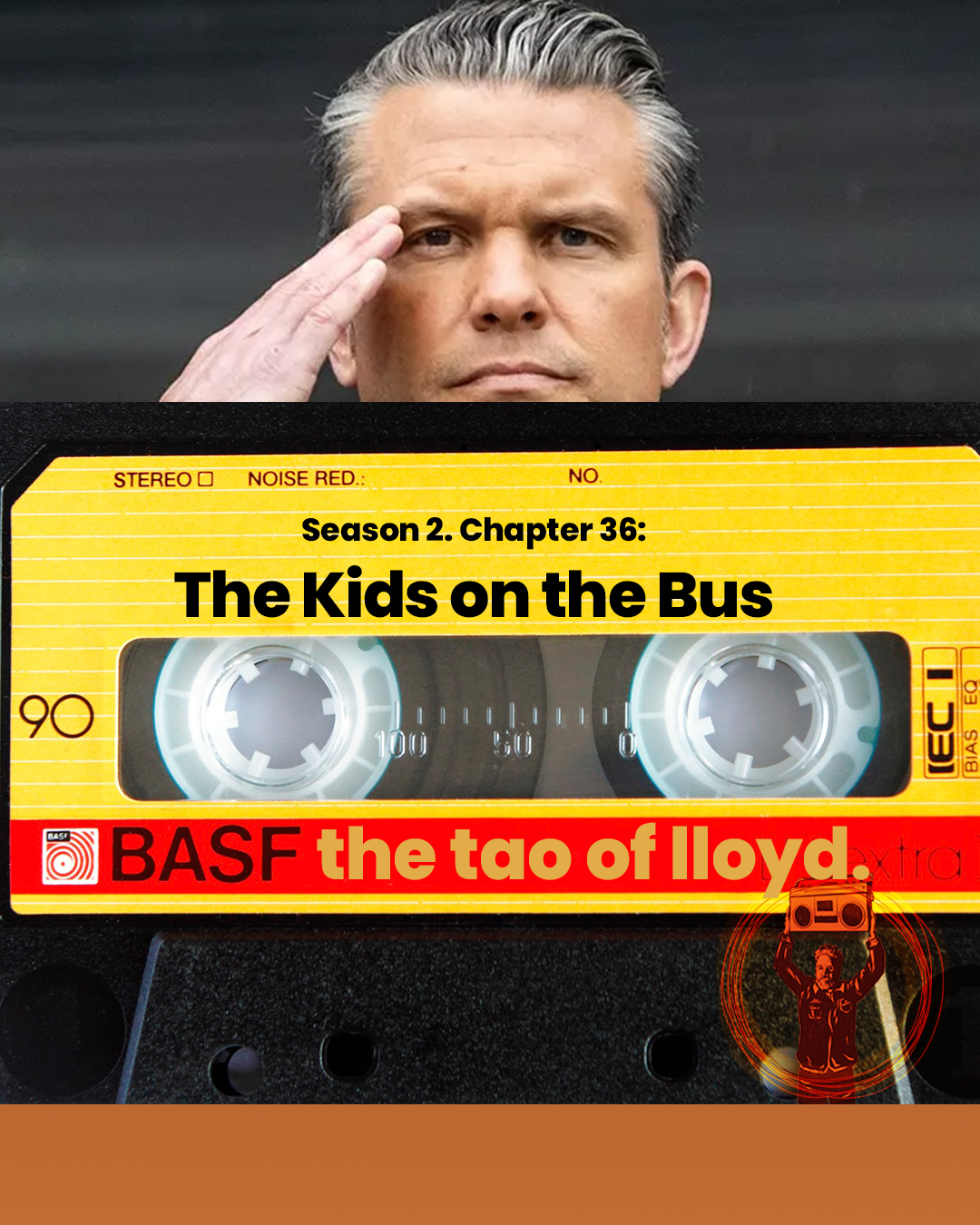
A Tao of Lloyd podcast thumbnail featuring Pete Hegseth above a retro yellow cassette tape labeled “Season 2. Chapter 36: The Kids on the Bus,” blending Cold War nostalgia, masculinity, and political commentary.
-
I know we’re all exhausted. I know we live in a timeline where every news alert feels like a rejected monologue from a straight-to-streaming dystopian reboot of A Few Good Men.
But Pete Hegseth’s gave a commencement speech at West Point recently?
That one stuck with me.
Because it was a speech about what kind masculinity America now considers acceptable.
About what kind of softness America now considers unforgivable.
It was a speech about white male fear.Pete Hegseth: “you can't throw your pronouns at the enemy. our diversity is our strength the single dumbest phrase in military history diversity is not our strength unity is our strength.”
And as a white male, that chafes my fucking hide because I grew up inside that mythology. Emotions were weakness, domination was strength, and softness was something you beat out of yourself before somebody else did it for you. I didn't learn it from a textbook. I learned it the way kids learn everything: on the school bus, in the air, in the songs we sang without knowing what we were singing.
And that version of masculinity is just another subscription I don’t want auto-renewing.
I want its brains beaten in.
I know I know I know…Even my internal metaphor for healing arrives carrying a baseball bat wrapped in barbed wire.
American masculinity is so deeply installed in the operating system that sometimes even the resistance to it sounds like an action movie trailer voice-over guy yelling
“This summer… emotionally unavailable men attempt healing by punching abstract concepts to death.”
And this unity Hegseth speaks of?When a guy with Crusader tattoos starts talking about “unity” and “anti-American ideologies” and sneering at diversity from behind a podium draped in flags, what he’s really selling isn’t unity.
It’s:
One nation.
Under God.
With suspicious definitions of both.And yes, I’ve said it before and I’ll say it again, The Secretary of War is a white Christian nationalist. I mean, when your version of Christianity sounds less like “blessed are the poor” and more like a Monster Energy drink sponsoring the Crusades… maybe we should ask a few follow-up questions.
Like: Why does Hegseth keeps circling the same Christian warrior masculinity?
Why does Hegseth keep pitching us his idea of Civilizational decline?
When Hegseth and company stoke fears that the “real America” is disappearing, whose ears are they trying to perk up with this dog whistle?
And this mythology always presents itself as strength.But it’s profoundly fragile.
Because if your civilization can be destroyed by pronouns… your civilization might just be a sandcastle puffing out its chest at the incoming tide.
And underneath all of it, I hear terror.Terror that the country is changing.
Terror that whiteness no longer gets to feel invisible.
Terror that masculinity itself might have to evolve emotionally or spiritually beyond domination.And maybe that’s why softness scares these guys so much.
And why these guys are obsessed with hardness.Hard men.
Hard power.
Hard borders.
Hard truths.Everything sounds like a Hims erectile dysfunction commercial marketed by a dying empire.
Like the entire country is a reality show convinced civilization will collapse because somebody said “they/them” at a faculty meeting.
[beat]
And look, I’ll admit something.
There’s a part of me… there’s a part of me that envies Pete Hegseth.
Not the politics.
Not the cruelty.
Not the Fox News action-figure energy.The certainty.
He walked up to that podium and handed those graduates a story
in which they are the heroes,
the enemy is legible,
and the mission is clean.Simple sentences.
Subject. Verb. No subordinate clauses.And the room erupted.
And I’m over here with a Tao Te Ching trying to describe the shape of water to people drowning in it.
[beat]
So…let’s get ready for our meditation and chapter reading.
(BELL CHIME)let’s take one slow deep breath in.
Exhale like you just realized that half this country owes Mr. Rogers an apology.
and… close your eyes.Or don’t.
You might be driving.
You might be doomscrolling.
You might currently be a white guy named Brad listening to this podcast defensively while assembling a smoker on your back deck.No judgment, Brad.
We’re all trapped in the same haunted escape room of American identity.
but go ahead and allow your eyes to close.And have no fear: I’m not your spiritual advisor.
I’m just Lloyd Dobler.
Yes.
That Lloyd Dobler.The boombox teenager from the 1980s movie Say Anything.
And due to a catastrophic glitch in the quantum physics of intellectual property, I now periodically appear inside our collapsing civilization to duct tape Taoist philosophy to your doomscroll.
This is Chapter 36 of the Tao Te Ching.If you want to shrink something,
you must first allow it to expand.
If you want to get rid of something,
you must first allow it to flourish.
If you want to take something,
you must first allow it to be given.
This is called the subtle perception
of the way things are.The soft overcomes the hard.
The slow overcomes the fast.
Let your workings remain a mystery.
Just show people the results.
[BELL CHIME]
I want to tell you a story I'm not proud of.And I mean that literally. Not the podcast-humble "I'm not proud of this" that precedes a mildly embarrassing anecdote.
I mean: I have carried this story around for forty-five years and I still don't know exactly what to do with it.
It's 1979. I'm nine, maybe ten years old. The Iranian hostage crisis is everywhere. Nightly news. Yellow ribbons. Jimmy Carter in his cardigan looking the way adults look when they've stopped being able to pretend everything is fine.
Gas lines. Rationing. The ambient national feeling that America had been humiliated and someone needed to pay for it.
And Reagan is coming. Reagan is already coming. You could feel it even at ten. The story was already being written: weakness did this. Softness did this. We need a hard man. We need unity.
[beat]
There was a girl on my school bus.
Her name was Layla.
Iranian American. Third grade, maybe fourth.
And one afternoon on the ride home from school, we all started singing.
To the tune of Barbara Ann. The Beach Boys. Except we changed the words to:
Bomb bomb bomb, bomb bomb Iran.
And I joined in.
We all joined in. In full 3-part harmony.
Nine and ten and eleven year olds, gleeful in our hatred.
And Layla sat there.
Looking out the window.
Not crying. Not saying anything. Just looking out the window, pretending not to hear us.
I didn't learn that song at home. My parents weren't cruel people. I learned it the way you learn anything at ten: it was just in the air. It was the default setting.
It was the shape of the water.Pete Hegseth would have loved that school bus. One nation. One song. Clear enemy. No pronouns involved.
The Tao says: If you want to get rid of something, you must first allow it to flourish.
I've been thinking about Layla for forty-five years.
Not constantly. But she comes back at moments like this one. When I hear a speech about unity and I recognize the song underneath it.
I know that song.
I sang that song.
And the fact that I was ten doesn't fully absolve me and the fact that it was everywhere doesn't fully explain it and the fact that I'm ashamed of it now doesn't do a single thing for her.
She looked out that window and survived the bus.
I hope she's okay. I hope the country she grew up in eventually felt like hers. But I know it probably didn’t.
[beat]
That's what Pete Hegseth is selling.
Not strength.
The song.
The gleeful, unified, ten-year-old song that feels like belonging and that belonging feels so fucking good, so fucking affirming, so addicting that you need a them who's looking out the window to define the us.
[beat]
I'm not that kid anymore.
I'm also not not that kid, because, you know, the operating system runs deep.
What if the most dangerous thing we can do right now is just refuse to sing along?
The soft overcomes the hard.From the edge of empire and the center of self — this is The Tao of Lloyd.
-
Info and tickets:
August 6- 30, 2026 | Edinburgh Festical Fringe.
Boombox romantic, Lloyd Dobler (Say Anything) returns!
Seriously unserious, devoutly disobedient, still refusing to buy, sell or process anything. Now a Zen-punk dissident duct-taping ancient spiritual wisdom to the collapse of the American empire, with deep gratitude and zero credentials, like a sticky note saying: 'Be kind. Rewind. Revolt'. Join Lloyd in a kinda-sorta guided meditation to survive late-stage effin' everything... Like a vinyl record spinning in a microwave of manifest destiny, humming: 'Oh well. Whatever. Never-mind.' Written and performed by Dennis Trainor Jr. (Manifest Destiny's Child), directed by Olivier winner Guy Masterson
Independent work like this survives because people decide it should.
This project is independently written, performed, produced, and sustained without ads, paywalls, or corporate backing.
Listener support helps cover the real cost of making each episode and protects the freedom to keep making it this way.
A recurring contribution helps most because it creates steadiness behind the work. But any support matters. Thank you.